

Electronic Trading Platforms in IFSC: IFSCA-Approved Regulatory Framework, 2026
Introduction: Why Electronic Trading Platforms Matter for IFSC Financial Markets
Global financial markets are increasingly driven by technology-enabled trading infrastructure. Institutional investors, banks and financial market intermediaries rely on electronic trading systems to execute transactions efficiently across multiple asset classes.
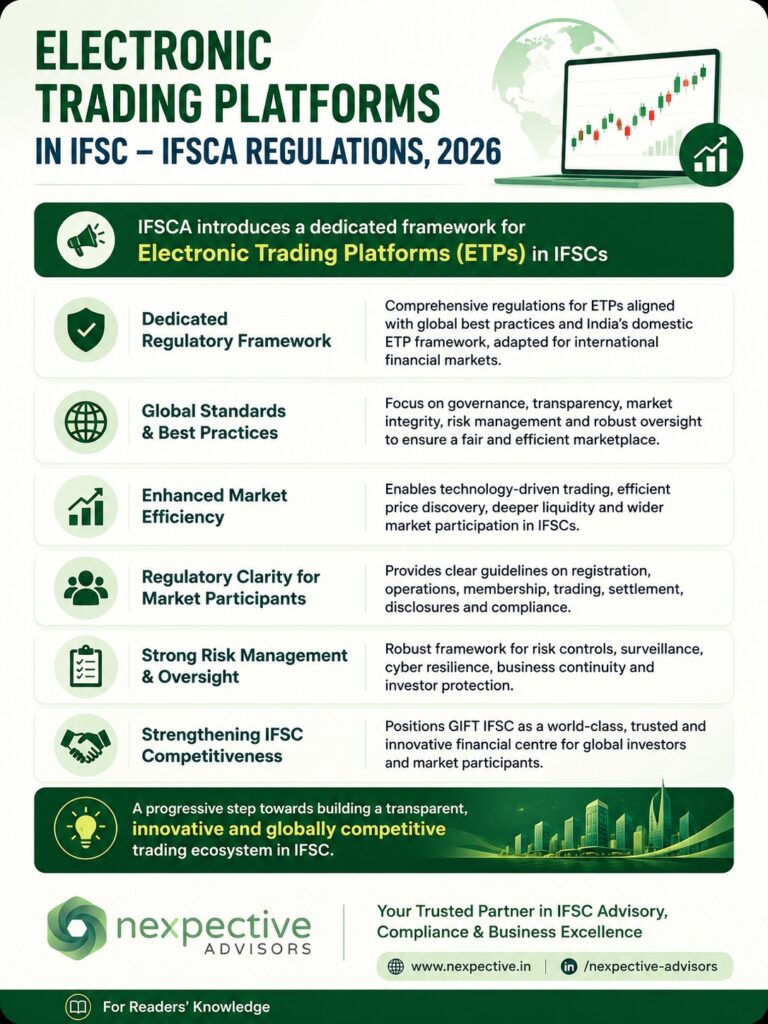
Recognising this evolution, the International Financial Services Centres Authority (IFSCA) has approved the IFSCA (Electronic Trading Platform) Regulations, 2026, establishing a comprehensive regulatory framework for Electronic Trading Platforms (ETPs) operating within IFSCs. The consultation process has now concluded, and the approved Regulations provide legal certainty for entities intending to establish and operate ETPs in GIFT IFSC.
Electronic Trading Platforms enable institutional participants to electronically trade eligible financial instruments through transparent and technology-driven systems. By introducing a dedicated regulatory framework, IFSCA aims to strengthen the electronic trading ecosystem, promote innovation, enhance market integrity and position IFSC as a globally competitive international financial centre.
Regulatory Update: IFSCA Approves Electronic Trading Platform Regulations, 2026
On 24 July 2026, the International Financial Services Centres Authority (IFSCA) approved the IFSCA (Electronic Trading Platform) Regulations, 2026.
The Regulations have been issued under Section 45W of the Reserve Bank of India Act, 1934, read with Section 13(1) of the International Financial Services Centres Authority Act, 2019, establishing a dedicated regulatory framework for the establishment, authorisation and operation of Electronic Trading Platforms (ETPs) in International Financial Services Centres (IFSCs).
The approved framework provides a clear legal and regulatory foundation for technology-driven trading platforms operating in IFSCs. It seeks to promote sound governance, market integrity, transparency, efficient price discovery, liquidity, operational resilience and regulatory certainty while aligning the IFSC ecosystem with leading international and domestic regulatory standards.
With the approval of these Regulations, the consultation phase has concluded and eligible entities can now refer to the final regulatory framework governing Electronic Trading Platforms in GIFT IFSC.
What is an Electronic Trading Platform (ETP)?
An Electronic Trading Platform (ETP) is a digital system through which financial instruments can be traded electronically among market participants. Unlike traditional exchanges that cater to both retail and institutional investors, ETPs are primarily designed for institutional participants such as banks, broker-dealers, asset managers, and financial institutions.
Under the IFSCA Electronic Trading Platform regulations, an ETP is defined as an electronic system located in IFSC through which offers for exchange, purchase, or sale of financial instruments are made by trading members. The platform may also facilitate the clearing and settlement of such transactions through its electronic infrastructure or through other arrangements.
ETPs play a key role in enabling efficient price discovery and liquidity in financial markets by providing automated execution and transparent trading mechanisms.
Key Characteristics of ETPs
Electronic trading platforms typically demonstrate several important features:
- Technology-driven execution: Orders are submitted, matched, and executed electronically without manual intervention.
- Institutional participation: Participation is generally restricted to qualified or institutional market participants.
- Alternative trading venues: ETPs complement traditional exchanges by providing specialized trading environments for certain asset classes or market segments.
- Flexible settlement arrangements: Unlike exchanges that rely on clearing corporations, ETP trades may be settled bilaterally between counterparties.
Difference Between ETPs and Traditional Exchanges
| Feature | Electronic Trading Platform | Stock Exchange |
|---|---|---|
| Participant Base | Mainly institutional participants | Retail and institutional |
| Settlement Structure | Often bilateral | Clearing house-based |
| Market Structure | Alternative trading venue | Centralized trading market |
| Regulatory Model | Platform operator regulation | Exchange regulation |
As financial markets become increasingly digital and globalized, ETPs are becoming an important component of the broader financial market ecosystem.
Global Evolution of Electronic Trading Platforms
Electronic trading platforms are not unique to IFSC. Several major financial jurisdictions have developed regulatory frameworks governing similar trading venues, though they are referred to by different terminology.
In the United States, such platforms are known as Alternative Trading Systems (ATS) and are regulated by the Securities and Exchange Commission (SEC). In the European Union and the United Kingdom, similar platforms operate as Multilateral Trading Facilities (MTF) under the MiFID regulatory framework. Singapore recognizes such trading venues under the Recognised Market Operators (RMO) framework regulated by the Monetary Authority of Singapore (MAS).
The IFSCA (Electronic Trading Platform) Regulations, 2026 acknowledge these global regulatory frameworks and have been developed after reviewing comparable regimes in Singapore, the United States, the European Union, the United Kingdom, Hong Kong and India.
This global alignment is significant for IFSC because it facilitates the entry of international market infrastructure providers into GIFT City. Operators already authorized in certain jurisdictions may establish operations in IFSC either through an IFSC-incorporated entity or through a branch structure.
By harmonizing the IFSC regulatory framework with international trading platform regulations, IFSCA aims to position IFSC as a competitive global hub for electronic financial markets.
Legal and Regulatory Basis of the IFSCA ETP Framework
The regulatory framework governing ETPs in IFSC is built upon multiple legislative foundations. The authority for regulating such trading platforms primarily originates from the Reserve Bank of India Act, 1934, and the International Financial Services Centres Authority Act, 2019.
Section 45W of the RBI Act empowers the Reserve Bank of India to issue directions governing trading platforms dealing in financial instruments such as securities, money market instruments, foreign exchange instruments, and derivatives. However, within IFSC jurisdictions, these regulatory powers are exercisable by the International Financial Services Centres Authority under the provisions of the IFSCA Act.
In 2025, RBI issued the Electronic Trading Platforms Directions, which provided a regulatory structure for ETPs operating in domestic financial markets. Building on the RBI framework, IFSCA has now notified the IFSCA (Electronic Trading Platform) Regulations, 2026, establishing a dedicated regulatory regime for Electronic Trading Platforms operating within IFSCs.
The purpose of this regulatory framework is to ensure that electronic trading venues operating in IFSC maintain high standards of governance, transparency, and risk management while facilitating innovation in financial market infrastructure.
By establishing a clear regulatory foundation, IFSCA seeks to create confidence among global financial institutions, fintech platforms, and market infrastructure providers looking to operate within IFSC.
Authorisation Framework for ETP Operators
One of the central features of the Regulations is the requirement for operators to obtain regulatory authorisation before establishing an electronic trading platform in IFSC.
Under the approved Regulations, no entity can operate an ETP in IFSC without obtaining prior authorisation from IFSCA.
Eligibility Requirements
While evaluating an application for authorisation, IFSCA considers several important factors, including:
- Financial strength and track record of the applicant
- Expertise and experience of management personnel
- Robust internal control and risk management systems
- Ability to employ qualified professionals
- Viability of the business model and business plan
These criteria ensure that only credible and capable institutions are permitted to operate trading platforms within IFSC.
Corporate Structure of ETP Operators
The Regulations require the ETP operator to either:
- Establish a company incorporated in IFSC, or
- Operate as a branch of a foreign entity already authorised in eligible jurisdictions.
This structure allows international trading platforms to establish a presence in IFSC while maintaining regulatory consistency with their home jurisdictions.
Fit and Proper Requirements
The directors, key managerial personnel, and controlling shareholders of the ETP operator must satisfy stringent “fit and proper” requirements. These include demonstrating integrity, financial soundness, and absence of regulatory violations or criminal convictions related to financial markets.
Once granted, the authorisation remains valid until revoked by the Authority or voluntarily surrendered by the operator.
Minimum Capital and Financial Requirements
Financial stability of trading platform operators is essential to maintaining confidence in the market infrastructure. Accordingly, the Regulations prescribe minimum capital requirements for ETP operators.
The regulations require that an ETP operator incorporated in IFSC maintain a minimum net worth of USD 250,000 or an equivalent amount in foreign currency at all times.
Operators that establish operations in IFSC through a branch structure must ensure that the parent entity maintains the required net worth for the branch operations.
In addition, ETP operators are required to submit an annual audited net worth certificate to the Authority confirming compliance with capital requirements.
IFSCA also retains the discretion to prescribe higher net worth thresholds depending on the scale, complexity, and risk profile of the trading platform’s business activities.
Compared to traditional market infrastructure institutions such as stock exchanges, the capital threshold for ETP operators is relatively modest. This reflects the regulatory intent to encourage innovation and participation by fintech firms and technology-driven trading infrastructure providers.
Eligible Instruments for Trading on ETPs
The scope of instruments that may be traded on Electronic Trading Platforms is clearly defined under the IFSCA (Electronic Trading Platform) Regulations, 2026.
ETPs may facilitate trading only in eligible financial instruments permitted under Section 45W of the RBI Act. These include:
- Securities
- Money market instruments
- Foreign exchange instruments
- Derivatives
- Other similar financial instruments as specified by the Authority from time to time
This framework allows ETPs to support trading in a wide range of financial market products relevant to institutional investors and financial institutions.
However, the Regulations also introduce an important restriction. The regulations explicitly clarify that cryptocurrencies or tokens, by whatever name called, are not permitted to be traded on ETPs.
This exclusion reflects the current regulatory stance toward digital assets within India’s financial regulatory framework.
By clearly defining eligible instruments, the Regulations aim to maintain regulatory clarity while allowing flexibility for future financial products to be included within the trading ecosystem.
Membership and Participation Framework
Participation in an electronic trading platform occurs through trading members, who are entities authorized to place or accept orders on the platform.
The Regulations require ETP operators to establish fair, objective, and transparent membership criteria for admitting trading members. These criteria must be non-discriminatory and applied consistently to all participants.
Before admitting a participant as a trading member, the ETP operator must conduct due diligence to ensure that the entity meets certain standards. These include:
- Adequate reputation and credibility
- Relevant experience in financial markets
- Sufficient financial capacity
- Appropriate technological and operational infrastructure
Such due diligence helps ensure that only capable and responsible institutions participate in the platform.
To maintain transparency and traceability, trading members must also be uniquely identified using identifiers such as the Legal Entity Identifier (LEI), Permanent Account Number (PAN), or other equivalent identification mechanisms.
This structured membership framework strengthens regulatory oversight and ensures that trading activity on ETPs remains orderly and transparent.
Operational Governance and Market Integrity
The Regulations place significant emphasis on governance, operational resilience, and market integrity.
ETP operators must establish clear and legally binding operating rules governing trading on the platform. These rules must be objective, transparent, and enforceable against all trading members.
The operator must also implement systems and infrastructure that ensure efficient execution of trades and orderly functioning of the market.
Core Operational Requirements
ETP operators must establish systems for:
- Real-time monitoring of trading activity
- Dissemination of trading information to market participants
- Secure communication channels for members
- grievance redressal and dispute resolution mechanisms
Market Integrity Safeguards
To prevent market abuse and disorderly trading conditions, ETP operators must implement safeguards such as:
- pre-trade risk controls
- mechanisms to detect erroneous trades
- monitoring of abnormal price movements
- temporary trading halts during extreme market conditions
These measures are essential to maintaining trust and transparency in electronic trading markets.
Conclusion
The IFSCA (Electronic Trading Platform) Regulations, 2026 represent a significant milestone in strengthening the electronic trading ecosystem within GIFT IFSC. By introducing a dedicated regulatory regime for Electronic Trading Platforms, IFSCA has established a transparent and internationally aligned framework that supports technology-driven financial market infrastructure while maintaining high standards of governance, operational resilience and market integrity.
Drawing upon leading global regulatory models for alternative trading venues, the Regulations are expected to facilitate greater participation by international market infrastructure providers, fintech firms and institutional investors. The framework also provides regulatory clarity for entities seeking to establish and operate Electronic Trading Platforms within IFSC.
As electronic trading continues to reshape global financial markets, the approved Regulations position GIFT IFSC to support efficient price discovery, enhanced liquidity and innovation across eligible financial instruments. Over the long term, this framework is expected to strengthen IFSC’s role as a globally competitive international financial centre and a preferred destination for advanced financial market infrastructure.